


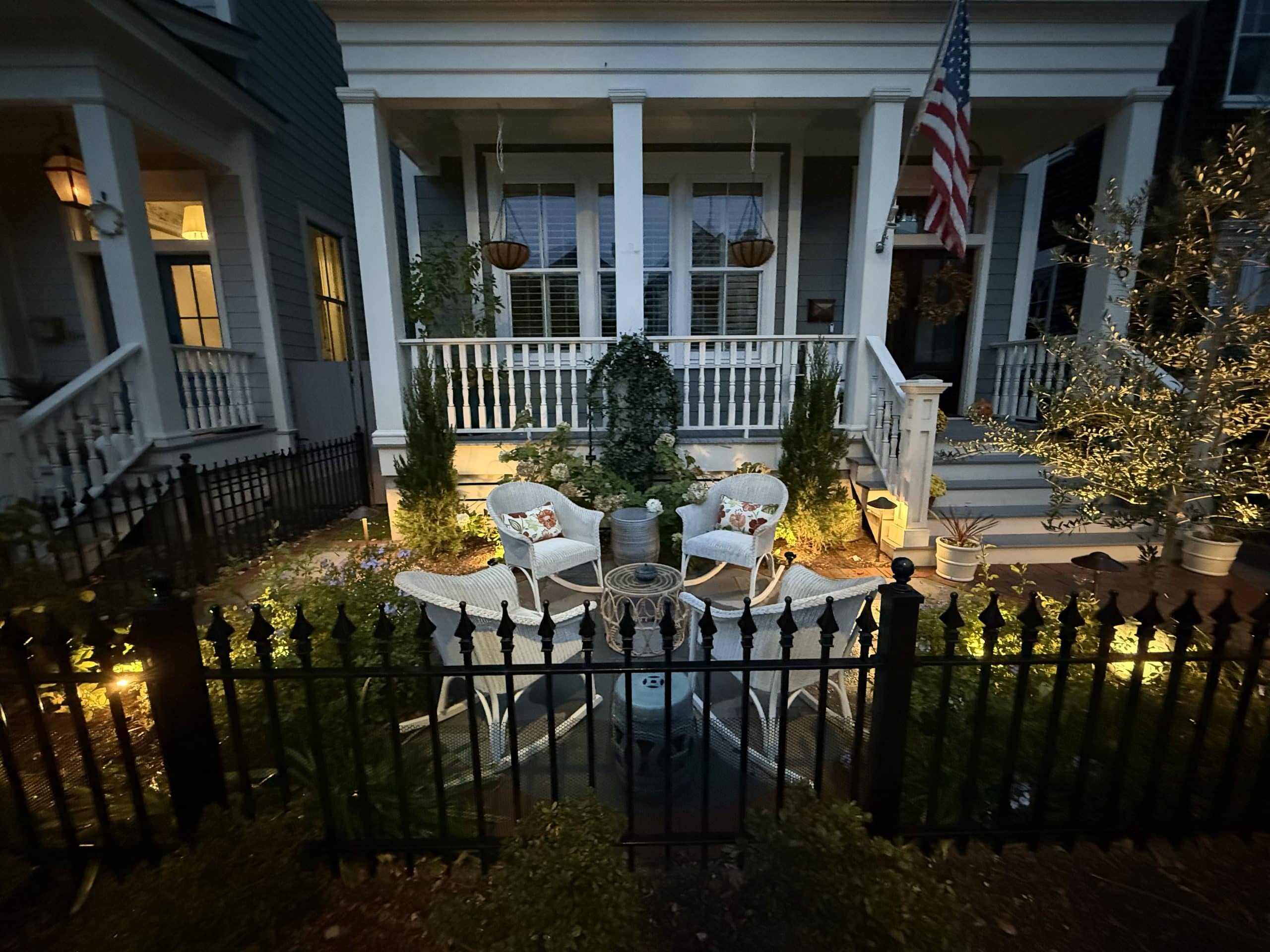
23 Nov Landscape Lighting in Savannah: Enjoying Your Garden After Dark
By November, it’s dark in Savannah before dinner is on the table. The garden you spent all year tending disappears right when the evenings finally turn comfortable enough to enjoy it.
Good landscape lighting gives those hours back. It lights the way to the front door, makes a courtyard usable after sunset, and lets the best parts of your landscape (a live oak, a fountain, a brick wall softened by vines) keep doing their work at night.
The key word is good. A row of bright stakes along a walkway isn’t a lighting plan. The landscapes that look best at night are lit with restraint: warm light, placed with intention, aimed at the things worth seeing. Below, we walk through the main types of landscape lighting, what makes lighting in Savannah a little different, and how we approach it at Victory Gardens, including a downtown courtyard we installed.
What Landscape Lighting Should Do
Before choosing fixtures, it helps to know what you want the light to accomplish. Most good plans balance three things:
- Safety. Steps, level changes, and paths should be easy to see, so no one is guessing where to put their feet.
- Use. A seating area, dining table, or courtyard should be comfortable to spend an evening in, not just visible from inside.
- Beauty. A few well-chosen features, like a specimen tree, a sculpture, or a water feature, should draw the eye and give the garden depth after dark.
What good lighting doesn’t do is light everything. Shadows are part of the design. When every inch of a yard is lit evenly, nothing stands out and the space reads more like a parking lot than a garden.
Types of Landscape Lighting
Most residential plans combine a few fixture types, each with its own job.
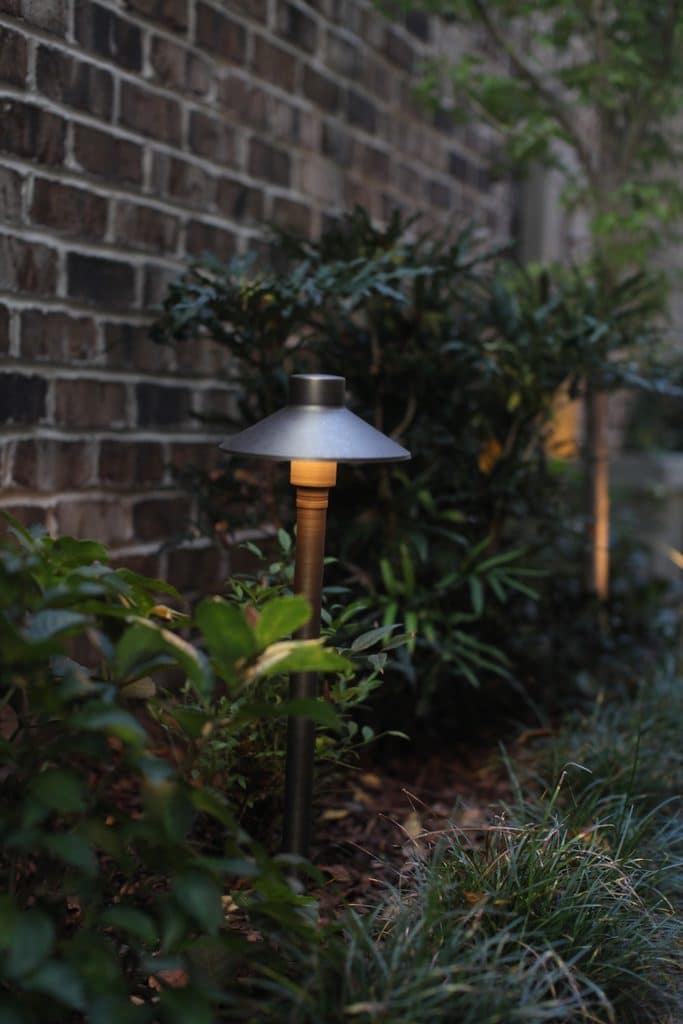
Path and Step Lighting
Path lights are low fixtures that cast light downward onto walkways, stepping stones, and bed edges. Step lights are built into or mounted beside stairs and level changes.
These are the workhorses of a lighting plan. The goal is pools of soft light that guide the way, not a runway. Spacing matters: lights placed too close together look busy, and lights placed too far apart leave dark gaps where you’d least want them. Tucking fixtures into the planting, rather than lining them up along the edge, helps them read as part of the garden.
Uplighting
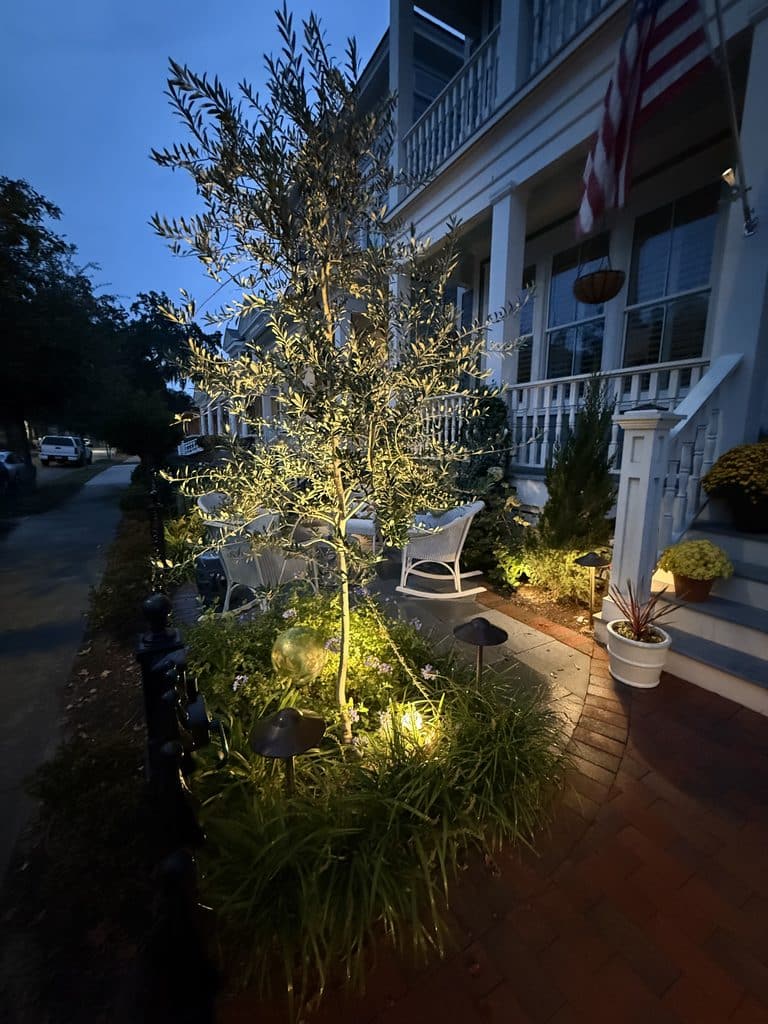
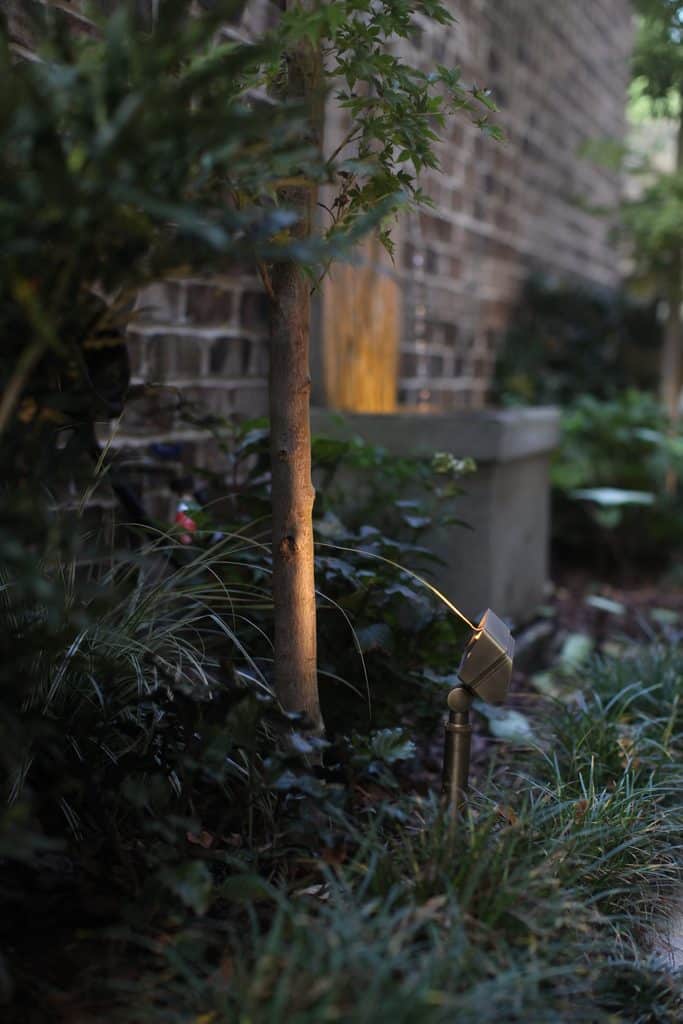
Uplighting places a fixture at the base of a tree, shrub, wall, or sculpture and aims it upward. It’s how you give a landscape height and drama at night.
In Savannah, uplighting a mature live oak is one of the most striking things you can do with light. The canopy, the branching, and the Spanish moss all take on a new character after dark. Larger trees often look best lit from more than one angle, so the trunk and canopy have dimension instead of looking flat.
Well Lights
Well lights are a type of uplight set into the ground, so the top sits flush with the soil or lawn. You see the light, not the fixture.
They work well in lawns, open beds, and anywhere a visible fixture would get in the way of mowing, foot traffic, or the look of the space. In our sandy soils and high water table, drainage underneath them matters, so water doesn’t collect around the fixture. (For more on how water moves through coastal soils, see our guide to rain gardens for coastal Georgia.)
Hardscape Lights
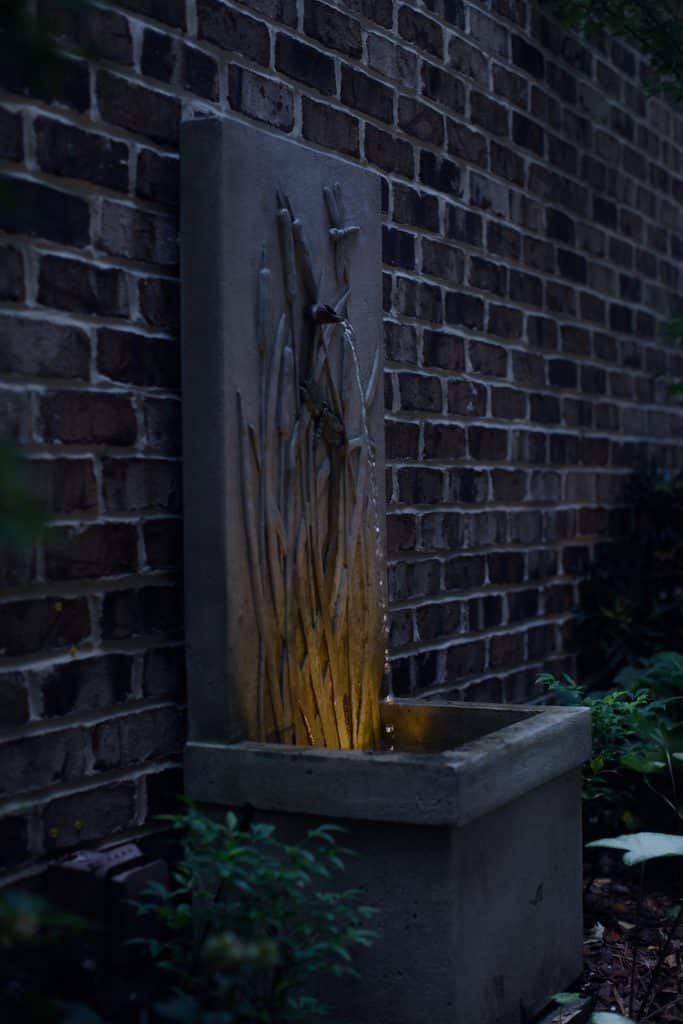
Hardscape lights are low-profile fixtures mounted into or onto built elements: under a wall cap, in a seat wall, on a stair riser, or along the face of brick. They light the surfaces around them with a soft wash.
Because they’re built into the hardscape, they’re best planned while that work is being designed. They’re especially well suited to Savannah’s courtyards, where brick walls and stone paving are often the backdrop for everything else.
Café Lights
Café lights, also called string lights, are strung overhead across a courtyard, patio, or pergola. They’re less about highlighting the landscape and more about atmosphere: they make a dining or gathering area feel like a place to stay.
We hang them from posts, pergolas, or the house, rather than wrapping or fastening them to trees, so they don’t damage bark or limbs as the tree grows. If you’re planning a gathering space, our guide to outdoor living spaces in Savannah covers how lighting fits alongside seating, pergolas, and fire features.
What Makes Lighting in Savannah Different
The basics of landscape lighting are the same everywhere. A few local conditions shape how we apply them here.
Salt air and humidity. Coastal air is hard on metal and electrical connections, especially closer to the marsh and the islands. Fixture material and connection quality matter more here than in many places. For more on how coastal conditions affect a landscape, see our guide to landscaping for Savannah’s coastal conditions.
Fast-growing gardens. Savannah landscapes grow quickly. A fixture that’s perfectly placed at installation can be buried in foliage a season later. We plan lighting around how plants will look in a few years, not just on day one.
Courtyards and walled gardens. In the Historic District, many outdoor spaces are compact and enclosed by brick. Light bounces off those walls, so a little goes a long way, and glare into neighboring windows is a real consideration.
Wildlife. We think about the creatures that share the garden, too. Lighting that’s aimed carefully, shielded, and on a timer is better for nocturnal wildlife and for the night sky. On Tybee Island, beachfront properties are subject to the city’s sea turtle lighting rules during nesting season, so check the current requirements before planning any lighting visible from the beach.
How We Approach a Lighting Plan
At Victory Gardens, we treat lighting as part of the landscape design, not an add-on at the end. A few principles guide our plans:
- Start with how you use the space at night. Where do you walk after dark? Where do you sit? What can you see from inside the house? Those answers set priorities.
- Light what matters, not everything. We pick a few focal points and let the rest of the garden fall into soft shadow.
- Keep the light warm. A warm white feels natural in a garden and flattering on plants, brick, and stone. Cool, bluish light tends to look harsh.
- Hide the source. The best lighting shows you the effect, not the fixture or a bright point of glare.
- Plan it with everything else. Wiring is easiest to run before hardscape and planting go in. When lighting is designed alongside the rest of the landscape, fixtures can be placed exactly where they’re needed without disturbing finished work.
- Make it easy to live with. Timers and simple controls mean the lights come on when you need them, without anyone having to remember.
Lighting That Grows With the Garden
A lighting plan isn’t finished on installation day. Plants grow over fixtures. Mulch and soil shift. Storms knock lights out of alignment, and lenses collect debris.
Because we both install landscapes and care for them, we can keep lighting working as the garden matures: re-aiming fixtures, adjusting placement as plants fill in, cleaning lenses, and checking connections. Our fine gardening team already knows the landscape, which makes small lighting adjustments part of regular care rather than a separate service call.
Why Late Fall Is a Good Time to Plan Lighting
November is typically Savannah’s driest month, which makes it a practical time for the digging and wiring that lighting installation involves. Drier ground is easier to work in, and it’s less disruptive to lawns and beds than working in saturated soil.
The season also makes the case on its own. Days are at their shortest, holiday guests are coming and going after dark, and it’s easy to see which paths, steps, and corners of the garden feel unwelcoming at night. Those are exactly the things a lighting plan should address.
Because we design, install, and maintain landscapes, lighting fits naturally into the work we’re already doing on your property. If you have a season in mind for enjoying new lighting, it helps to reach out early, since design-build projects are scheduled ahead.
Project Spotlight: A Downtown Compact Courtyard
For this project, the homeowners wanted to turn a small downtown courtyard into a serene retreat surrounded by nature and art. Soft evening lighting was part of the plan from the start, along with a side path, comfortable seating, dining for two, lush plantings, room for their sculpture and art collection, and the sound of a water feature.
Landscape designer Paul Daniels of Paul Daniels Design created the plan, and Victory Gardens installed it, including the lighting, hardscape, fountain, plantings, irrigation, and carpentry for the entrances and deck.
The lighting is quiet and layered. Low path lights guide the way along the stepping stones from the garden gate. A specimen tree and a Japanese maple are lit from below, so they stand out against the brick. A wall-mounted fixture casts a warm wash over the border plantings. Nothing is overlit, and in a space this compact, that restraint is what makes it work.
The result shows that lighting doesn’t need a big yard to make a big difference. In a small courtyard, a handful of well-placed fixtures can turn a space you pass through into one you stay in. Today, we continue caring for this landscape through our fine gardening services.
What to Expect When Working With Victory Gardens
Our design-build process begins with getting to know your property, how you hope to use it, and your budget. That early conversation helps confirm the project is a good fit. From there, the project moves into design, either created by our team or in partnership with an independent landscape designer, and our own crew handles installation from start to finish. Afterward, many clients continue with our fine gardening program to keep the landscape, and the lighting, looking its best.
Frequently Asked Questions
How much does landscape lighting cost?
Every project is different, and lighting cost depends on the size of the property, the number and type of fixtures, and how much wiring is involved. Budget is part of the conversation from the very beginning.
Can lighting be added to an existing landscape?
Yes. Lighting can be added to an established garden, though it’s simplest to plan during a new design or installation, when wiring can be run before hardscape and plantings are finished.
When is the best time to install landscape lighting?
Lighting can be installed year-round, but late fall is a good time to plan it. November is typically Savannah’s driest month, which makes digging and wiring easier, and the short days make it clear where light is needed most.
What type of light looks best in a garden?
Warm white light generally looks most natural on plants, brick, and stone. We also favor fewer, well-aimed fixtures over many bright ones, so the garden has depth and shadow instead of being lit evenly.
What’s the difference between path lights, uplights, and well lights?
Path lights cast light down onto walkways and beds. Uplights sit at the base of a tree, wall, or feature and aim upward. Well lights are uplights set flush into the ground, so the fixture disappears and only the light shows.
How do fixtures hold up in Savannah’s coastal climate?
Salt air and humidity are hard on metal and electrical connections. Durable fixture materials and well-sealed connections make a real difference here, especially near the marsh and on the islands.
Can I put lights in my trees?
We light trees from the ground rather than attaching fixtures or string lights to them, so we don’t damage bark or limbs as the tree grows. Café lights are hung from posts, pergolas, or the house instead.
Do you maintain landscape lighting after it’s installed?
Yes. As plants grow and the garden changes, fixtures need re-aiming, adjusting, and cleaning. Many clients have this handled as part of our fine gardening program.
Are there lighting rules on Tybee Island?
Yes. Tybee Island has sea turtle lighting rules for beachfront properties during nesting season. If your property faces the beach, check the city’s current requirements before planning any exterior lighting.
Who installs landscape lighting near me in Savannah?
Victory Gardens designs, installs, and maintains landscape lighting throughout Savannah and nearby island communities, including the Historic District, Isle of Hope, Skidaway Island, and Tybee Island.
See Your Garden in a New Light
The evenings are some of the best hours to be outside in Savannah. If you’re ready to enjoy your garden after dark, explore our Design + Installation services or reach out to start a conversation about your project.