


07 Aug Rain Gardens for Coastal Georgia: Solving Drainage Without Sacrificing Beauty
By Kerry Shay, Co-Founder, Victory Gardens
Savannah’s landscapes are some of the lushest in the Southeast. From beautiful live oaks to fern-filled shade beds, everything seems to grow (and grow) without much coaxing. Heavy seasonal rainfall, a high water table, and warm, humid air can often keep the ground from ever fully drying out. Those same conditions are also what cause the drainage problems homeowners run into: standing water after a storm, mulch washing off a slope, erosion, water working its way toward the foundation. The lush gardens and the drainage problems come from the same source.
Traditional drainage solutions often treat water as something to move away as quickly as possible: bury a pipe, cut a channel, send runoff elsewhere. A rain garden takes a different approach. It manages the same water challenges while becoming a planted feature that adds beauty, habitat, and function to your landscape every time it rains.
This guide covers what a rain garden actually is, how it compares to other drainage solutions, and how we approach water on properties here in the Savannah area.
Why Drainage Is Different Here in Coastal Georgia
Water behaves differently on this part of the coast than it does further inland, for a few reasons:
- Flat topography. Even a small grading change can send water somewhere you weren’t expecting
- A high water table, especially the closer a property sits to the marsh or the coast
- Sandy topsoil that drains fast on the surface but can still perch water above a compacted subsoil or clay layer underneath
- Fast, intense summer storms rather than the slow, steady rain other regions get
The takeaway: good drainage starts with understanding how water moves across the whole property, not just the one spot where it happens to be showing up.
What Is a Rain Garden? (And What It Definitely Isn’t)
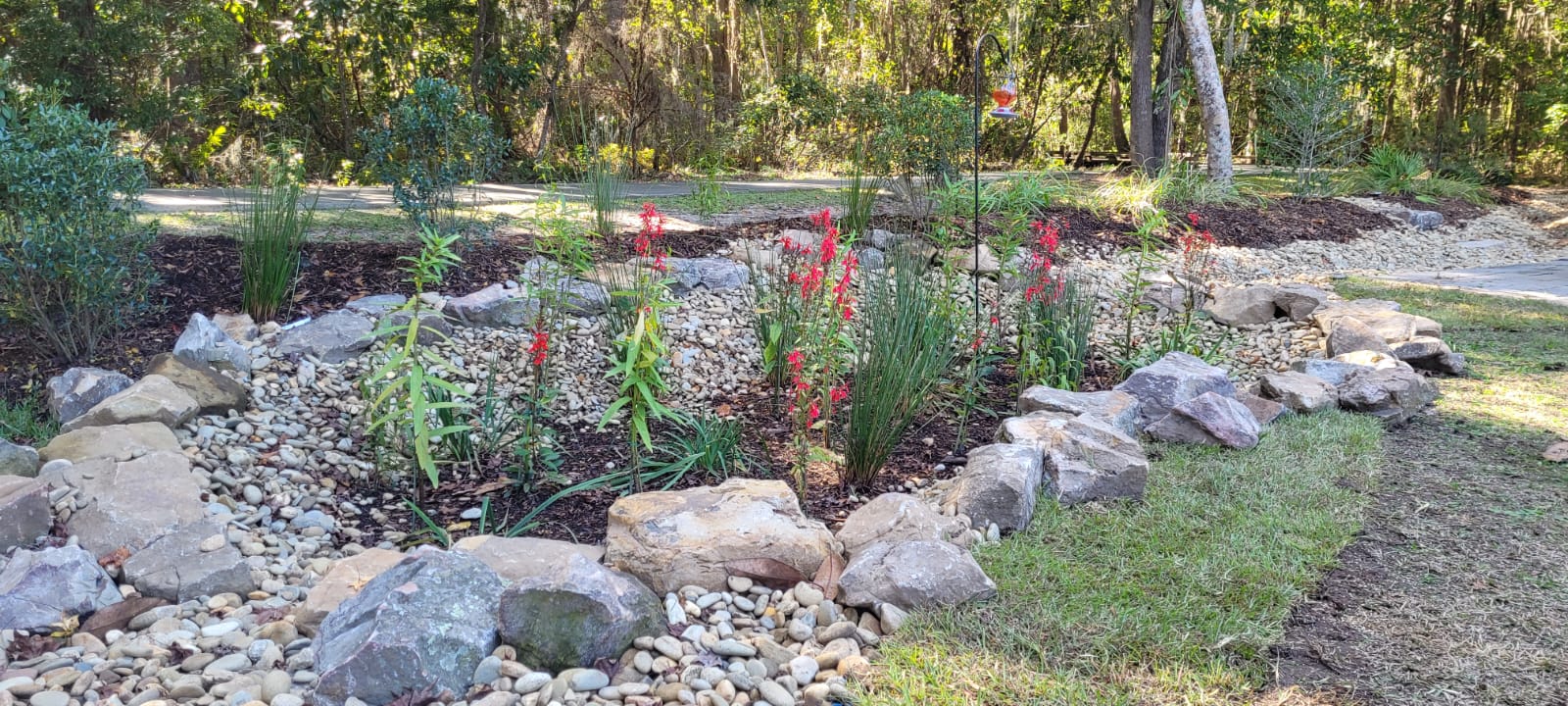
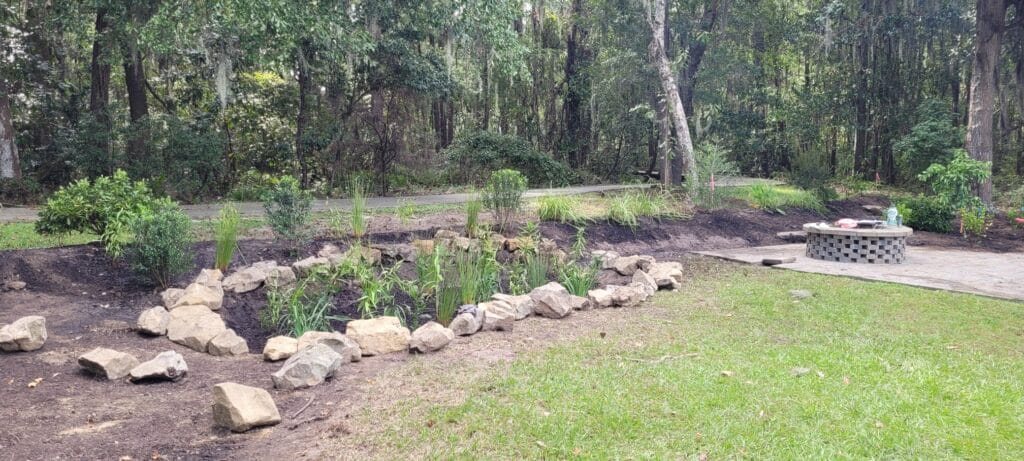
A rain garden is a shallow, planted basin, graded so runoff flows in and holds there just long enough to soak into the ground—usually 24 to 48 hours. That comes down to a few inches of slope, the right soil profile underneath, and plants with root systems built to handle wet conditions some of the time.
What it’s not: a pond, a swamp, a mosquito breeder, or a low spot in the yard nobody’s dealt with. The difference is in the design. A rain garden earns its place aesthetically too, with layered plantings that shift through bloom and texture across the seasons and a basin shaped so it reads as an intentional bed rather than a dip in the yard. The function and the beauty go hand in hand.
| Rain Garden | French Drain | Catch Basin | Dry Creek Bed | |
| What it is | A shallow, planted basin that captures and briefly holds runoff | A gravel-filled underground trench with a perforated pipe that redirects water elsewhere | A graded collection point that gathers surface water and feeds it into underground piping | A graded, stone-lined channel that carries surface water along a visible path |
| Best for | Absorbing runoff on-site while adding a planted feature | Moving water away from a foundation or low spot underground | Capturing heavy surface flow at a specific low point before it moves underground | Directing heavy surface flow from one area of the yard to another |
| Visible in the landscape? | Yes, designed as a planted feature | No, buried, invisible once installed | Discreet, reads as a grate, not a design element | Yes, designed to read as a landscape feature |
The right solution depends on the property. Many of the yards we work on end up with a combination: a rain garden handling the visible work near a patio, say, with a French drain routing water away from the foundation out of sight.
Signs Your Yard Might Be Telling You Something
- Water that’s still sitting there 24+ hours after the rain stopped
- Erosion or bare, exposed soil, usually on a slope
- Mulch that washes away every time it storms
- A patch of yard that stays soggy no matter the season
- Water creeping toward the foundation
- More mosquitoes than the rest of the yard after a storm
- Plants that won’t thrive despite decent care (often the moisture is the problem, not the plant)
Our Approach: Designing With Water, Not Against It
We start every drainage project by getting to know the property before we talk solutions. That plays out in three steps.
1. We figure out how water is actually moving.
Before we suggest anything, we walk the site and look at grading, soil, slope, and where runoff is really coming from and going. A soggy spot in the backyard often traces back to something happening on another part of the property, so we look at the whole site, not just the puddle you called us about.
2. We design the solution that fits the site.
Sometimes that’s a rain garden. Sometimes it’s regrading, a swale, a dry creek bed, native plants chosen for wet conditions, or drainage infrastructure underground. Often it’s a combination of these working together.
3. We turn the fix into something worth looking at.
A drainage solution doesn’t have to read as a utility fix bolted onto your yard. We design rain gardens to work as habitat features and native planting highlights, with real seasonal interest, so managing water and having a landscape you like end up being the same project.
Choosing Plants for a Savannah Rain Garden
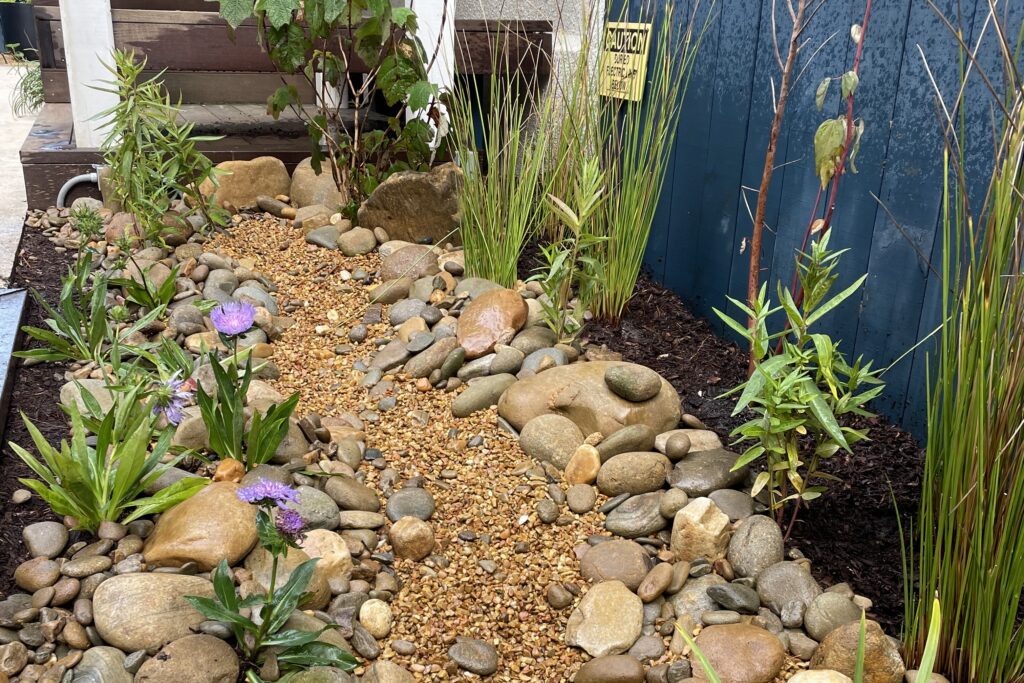
A rain garden isn’t planted the same way all the way through. The center of the basin can stay genuinely wet for days after a storm, while the edges dry out between rains. Plant the wrong thing in the wrong zone and it either drowns or dries out, so we group our go-to plants by where they’ll actually thrive.
Wettest Zone (Basin Center)
- Swamp Lily
- Fakahatchee Grass
- Swamp Sunflower
- Swamp Milkweed
- Blue Flag Iris
- Cardinal Flower
Transitional Zone (Edges and Slopes)
- Summersweet Clethra
- Joe-Pye Weed
- Purple Coneflower
- Rattlesnake Master
- Rudbeckia
- Fakahatchee Grass
- Purple Lovegrass
- Virginia Sweetspire
- River Oats
Every plant on this list is native, which matters for more than survival — they support the pollinators already living here, and once established, they need less intervention than something bred for a different climate.
Frequently Asked Questions
What is a rain garden and how does it work?
It’s a shallow, planted basin built to catch stormwater and let it soak into the ground gradually, usually within 24 to 48 hours. Grading steers the water in, and the soil mix and plant roots take it from there.
Do I need a rain garden or a different drainage solution?
That really depends on what’s going on in your yard. If the goal is capturing and absorbing surface runoff while adding a planted feature, a rain garden is a great fit. If water is pooling right up against the foundation or needs to move underground, a French drain is usually the better call. We’ll walk the whole property with you before recommending a direction.
Will a rain garden attract mosquitoes?
No, not when it’s built correctly. A properly graded rain garden drains within 24 to 48 hours, which is faster than mosquitoes need to breed. Standing water is the actual mosquito risk, and a rain garden is designed specifically to avoid it.
How deep should a rain garden be?
Most of ours come in around 12 to 24 inches deep, sometimes a bit more depending on the soil and what the site needs to handle. It really comes down to how fast the surrounding soil drains and how much runoff the basin has to manage.
Can a rain garden be added to an existing landscape?
Yes. A rain garden can be worked into an established yard without a full landscape overhaul, as long as there’s a natural low point or a spot that can be graded to create one.
What plants work best in a Savannah rain garden?
It comes down to moisture zone. Swamp lily, swamp milkweed, and cardinal flower are right at home in the wettest center of the basin, while summersweet clethra, Joe-Pye weed, and Virginia sweetspire do best out along the drier edges and slopes.
What’s the difference between a rain garden and a French drain?
A rain garden is a visible, planted feature that catches water at the surface and lets it soak in. A French drain is buried infrastructure—a gravel-filled trench with a perforated pipe— that moves water underground to a different location. One is a landscape feature; the other is meant to be invisible.
Does Victory Gardens handle grading and earthworks, or just planting?
Both, start to finish. Drainage work begins with understanding how water moves across a site, and we carry that all the way through installation, whether that means earthwork, planting, or a mix of the two.
How long does it take for a rain garden to establish?
Most rain gardens need one to two growing seasons to fully establish, though they’ll be capturing and draining water from the day they’re installed. Consistent watering during the first season, especially through summer, helps the plants build the root systems that make the garden low-maintenance long-term.
Let’s Design a Beautiful and Functional Rain Garden
Water has always been part of gardening on this stretch of coast. It’s the same reason our landscapes grow so beautifully here. Rather than fighting water, we design with it—just as we would with sunlight, soil, and seasonal change. A rain garden is one way to solve a drainage challenge while creating something that makes your landscape even better.
If you’re dealing with drainage issues or wondering whether a rain garden is right for your property, contact us and a member of our team will be in touch.
No Comments